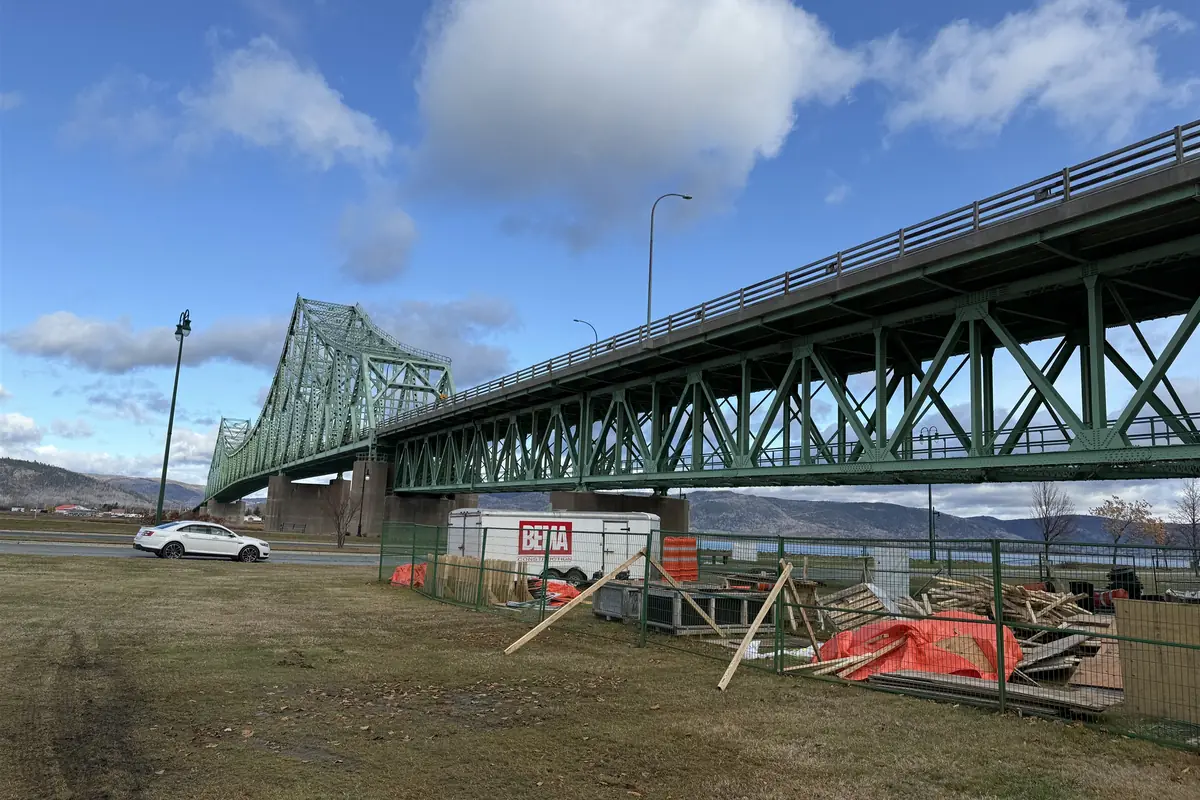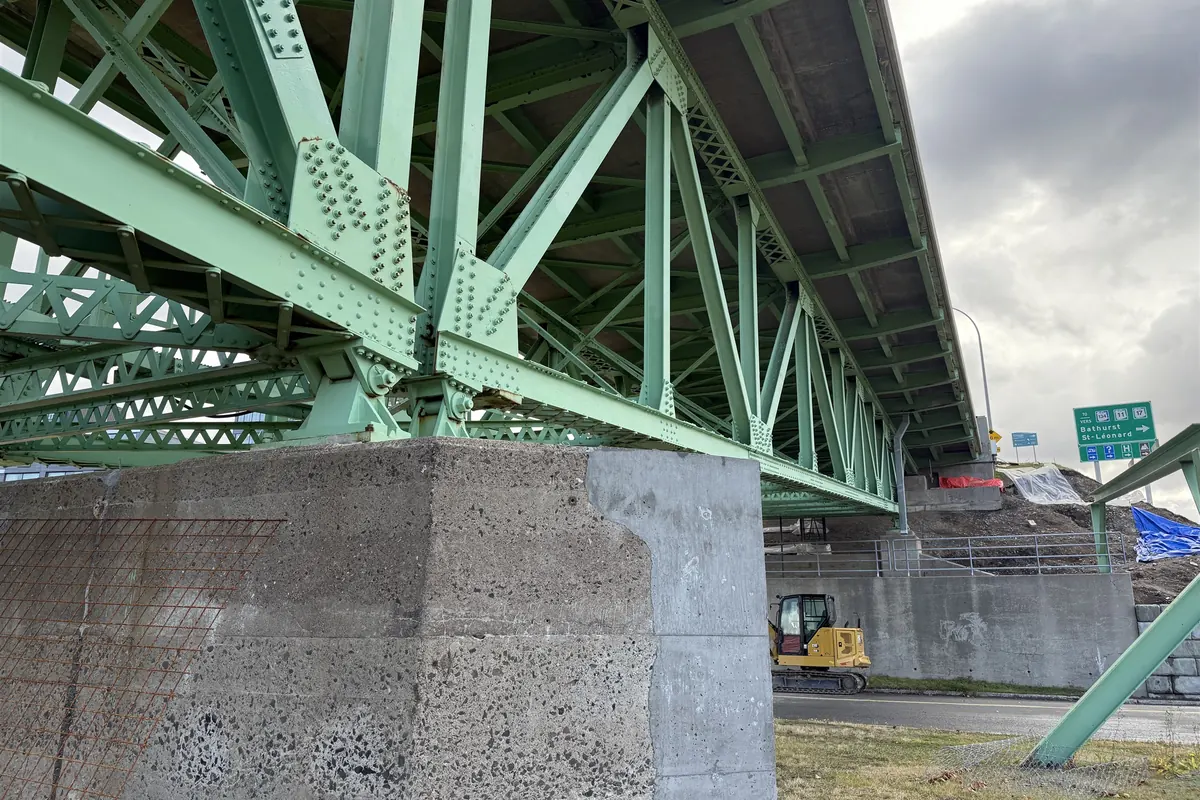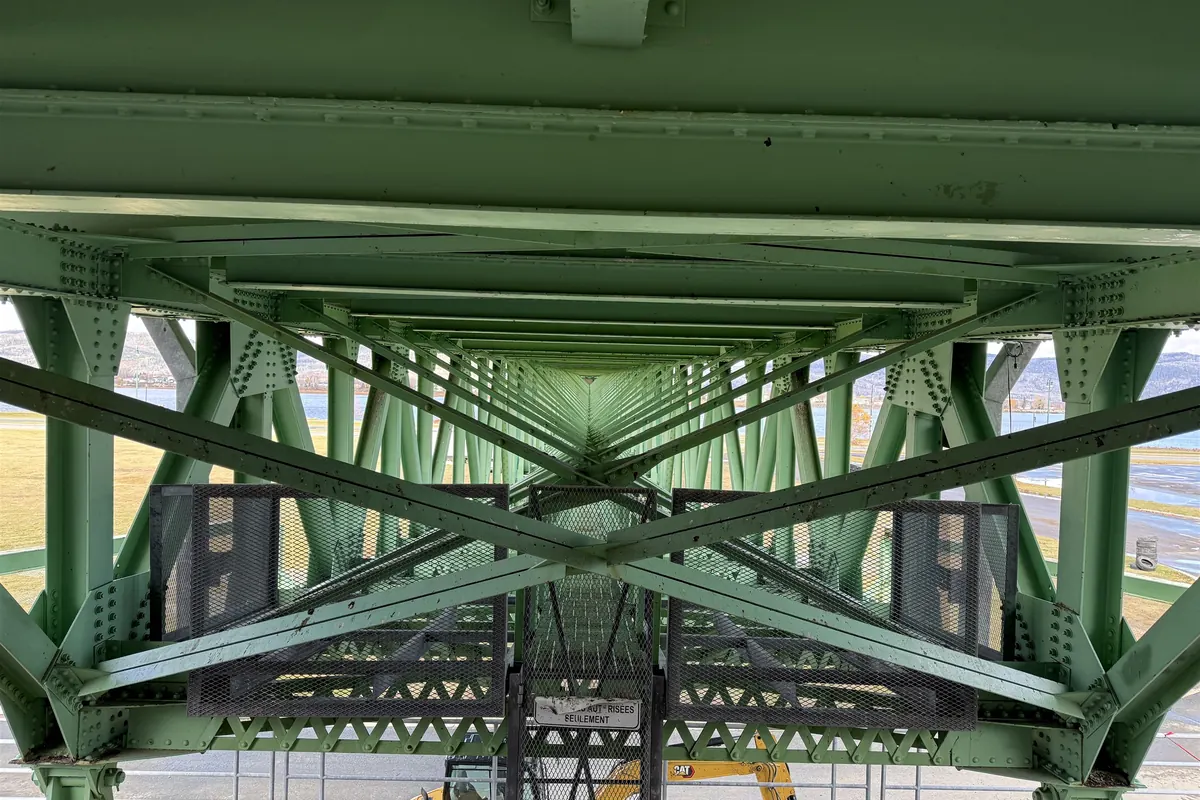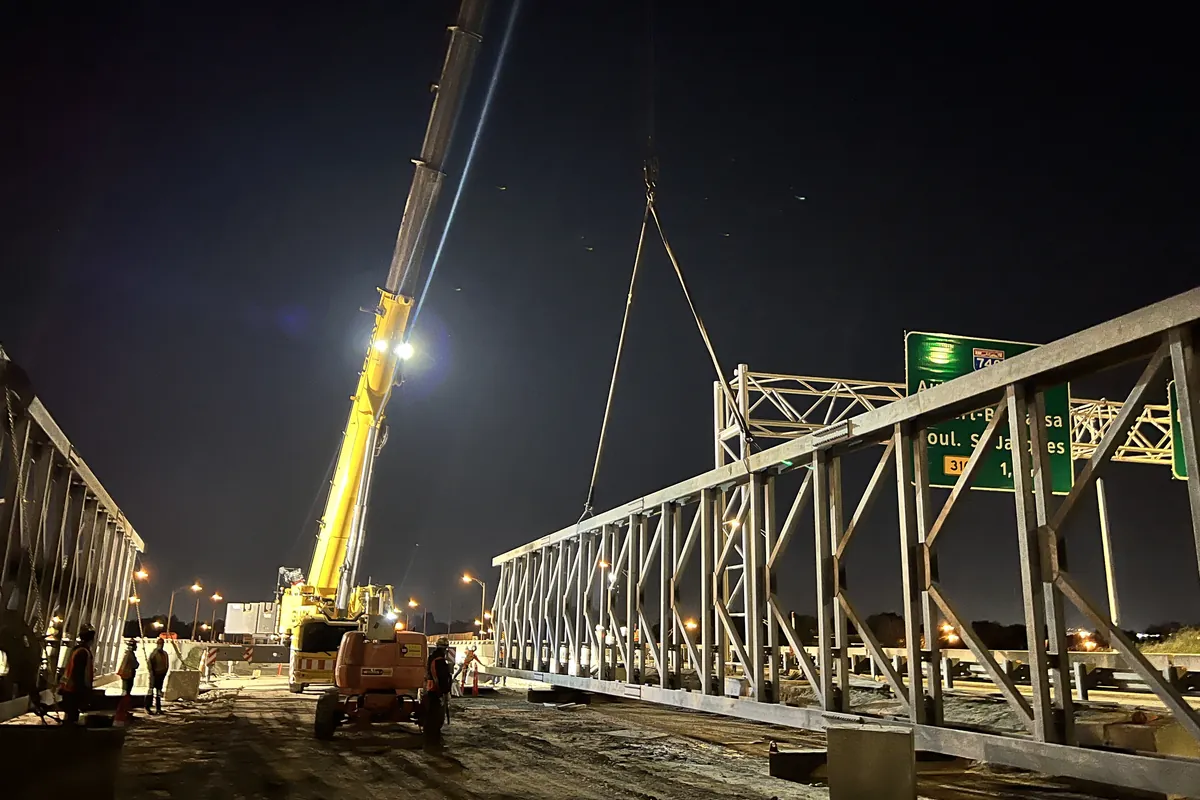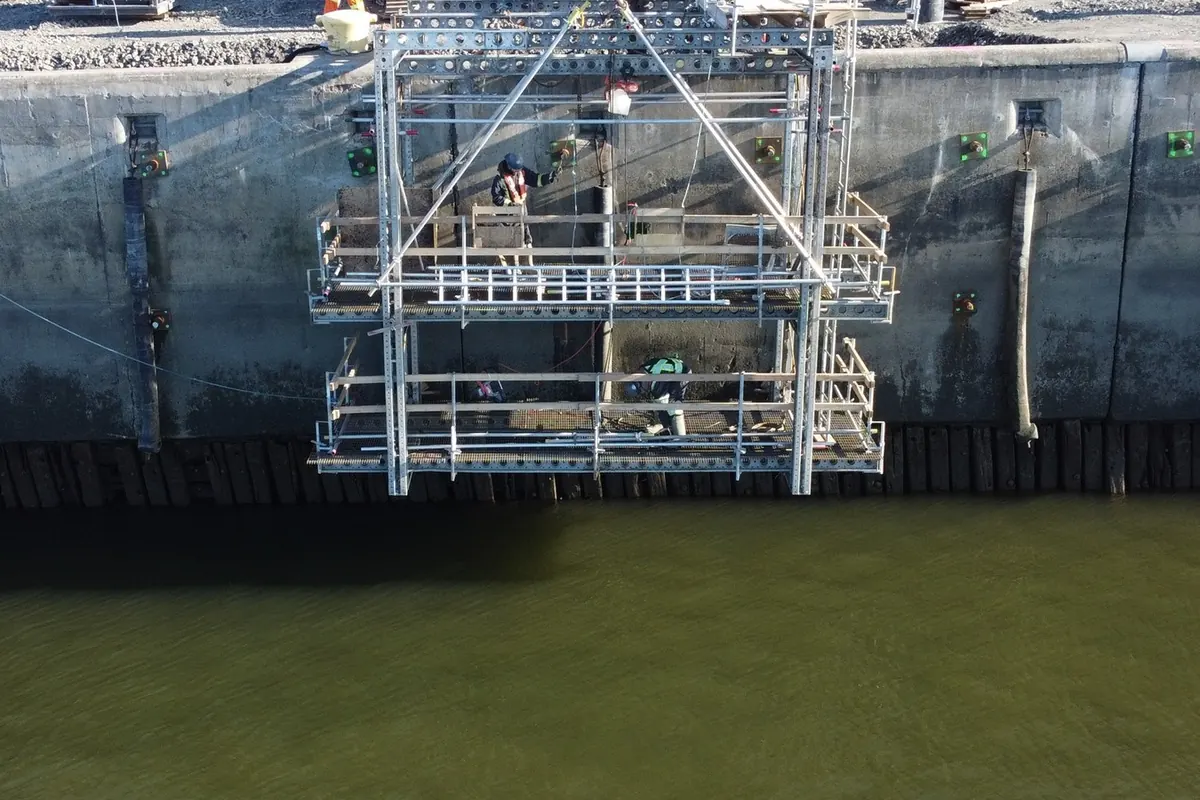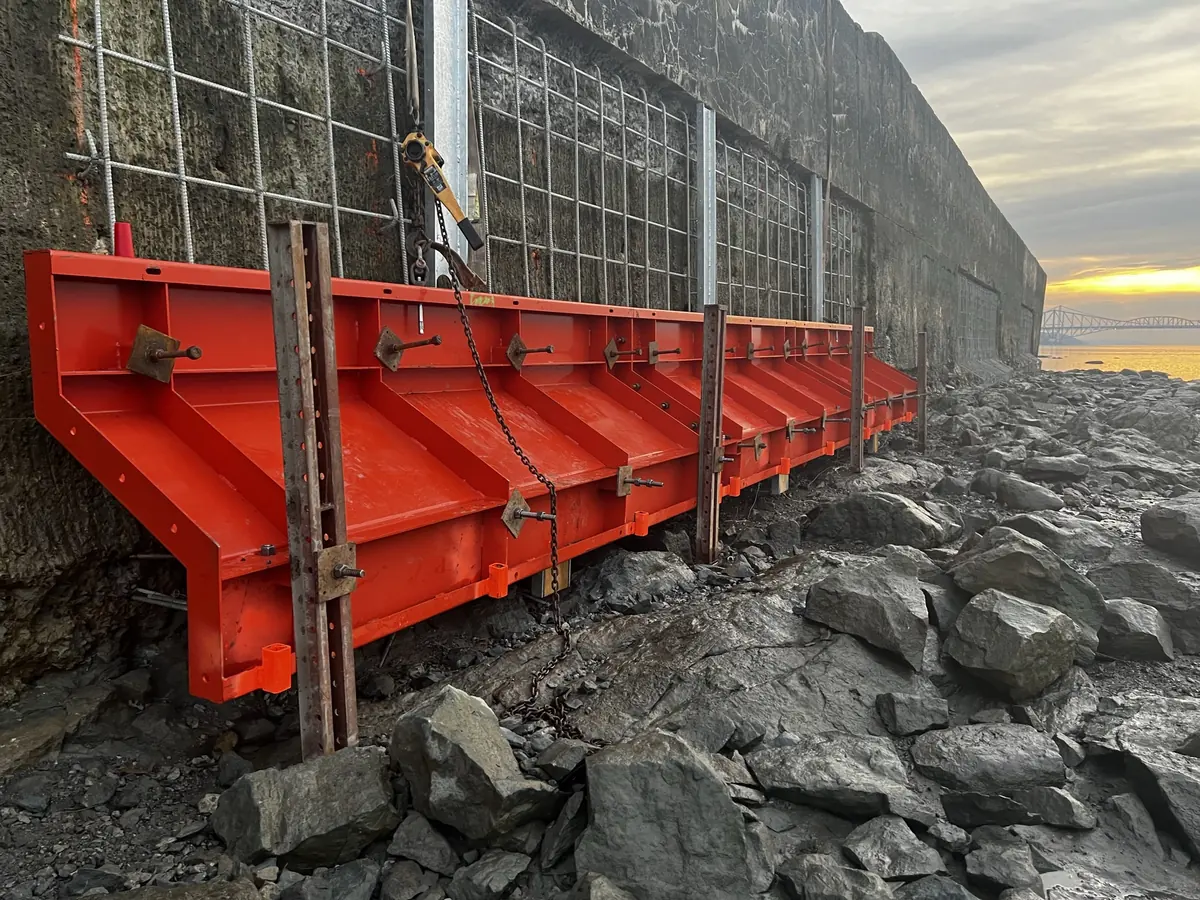
J.C. Van Horne Bridge site, Quebec – New Brunswick border
The challenge
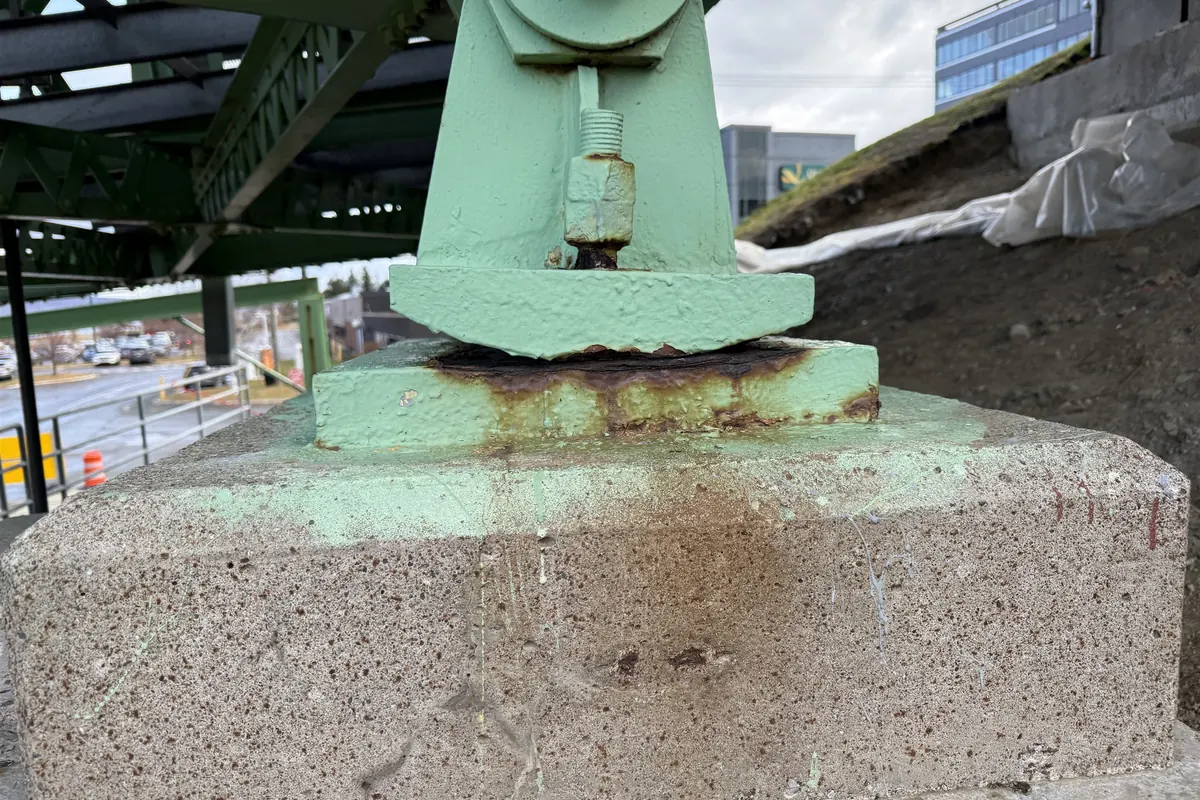
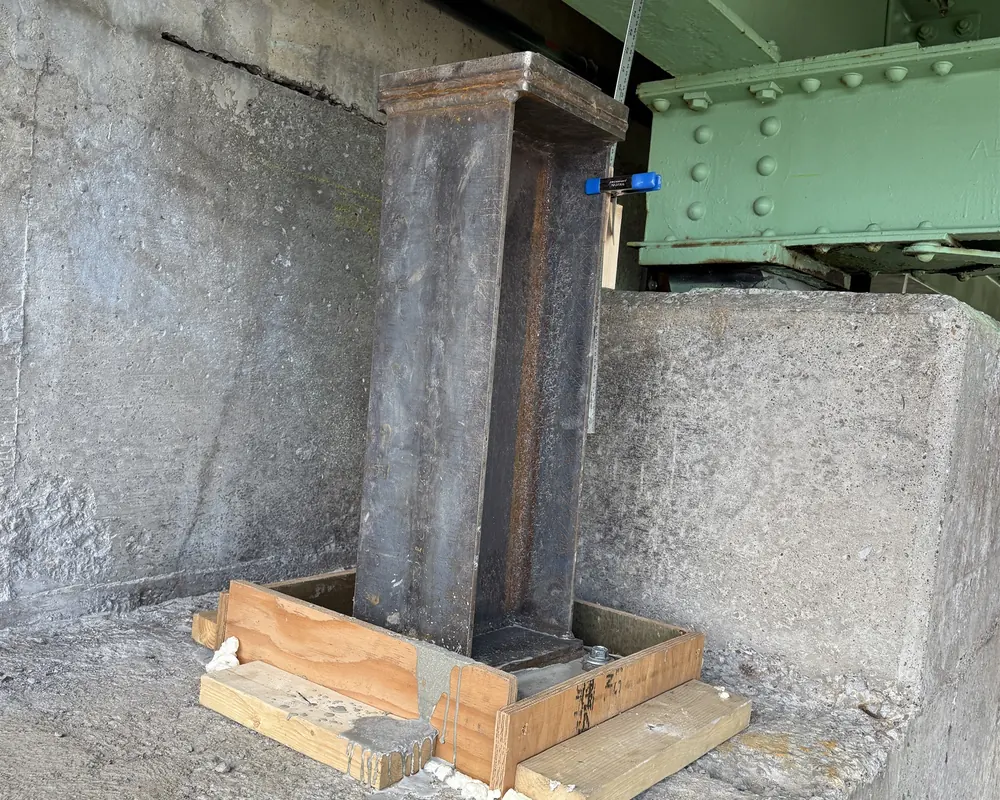
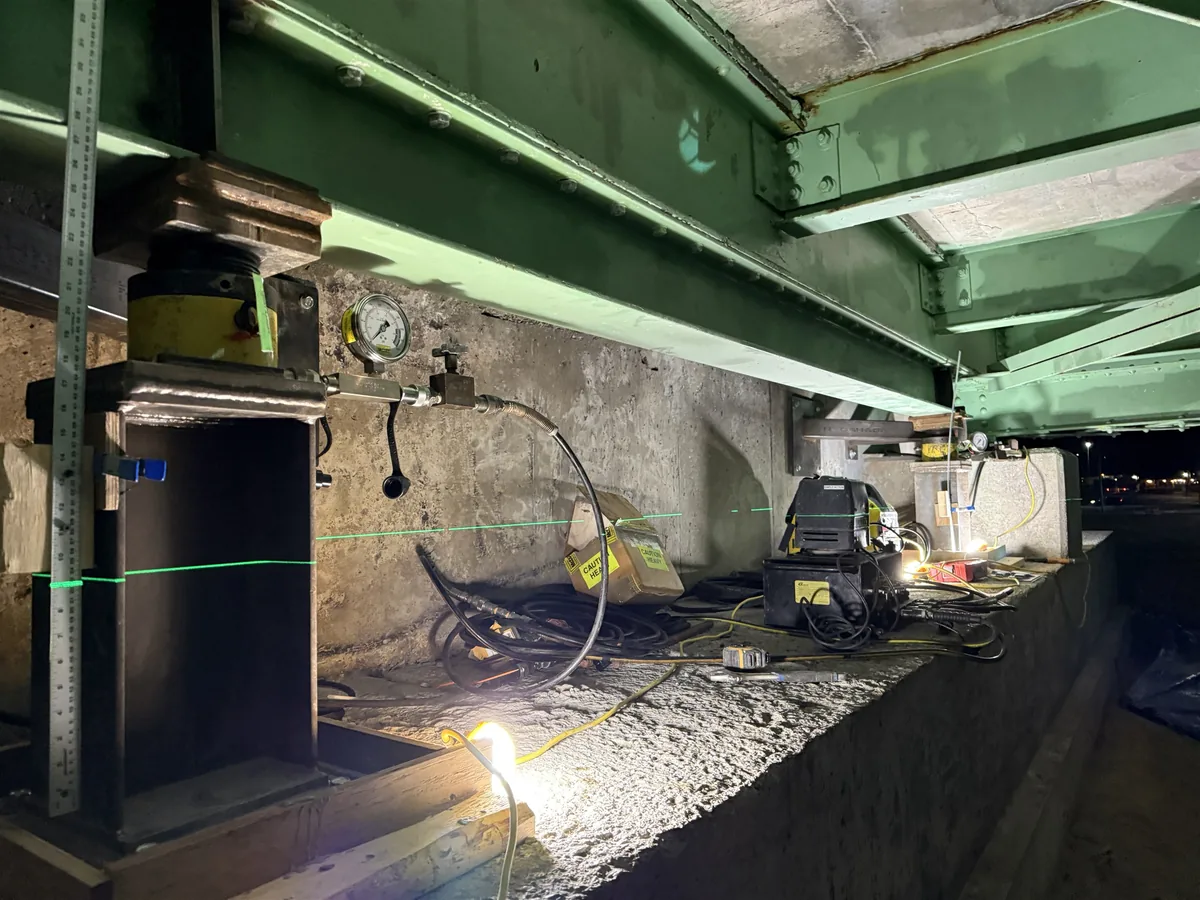
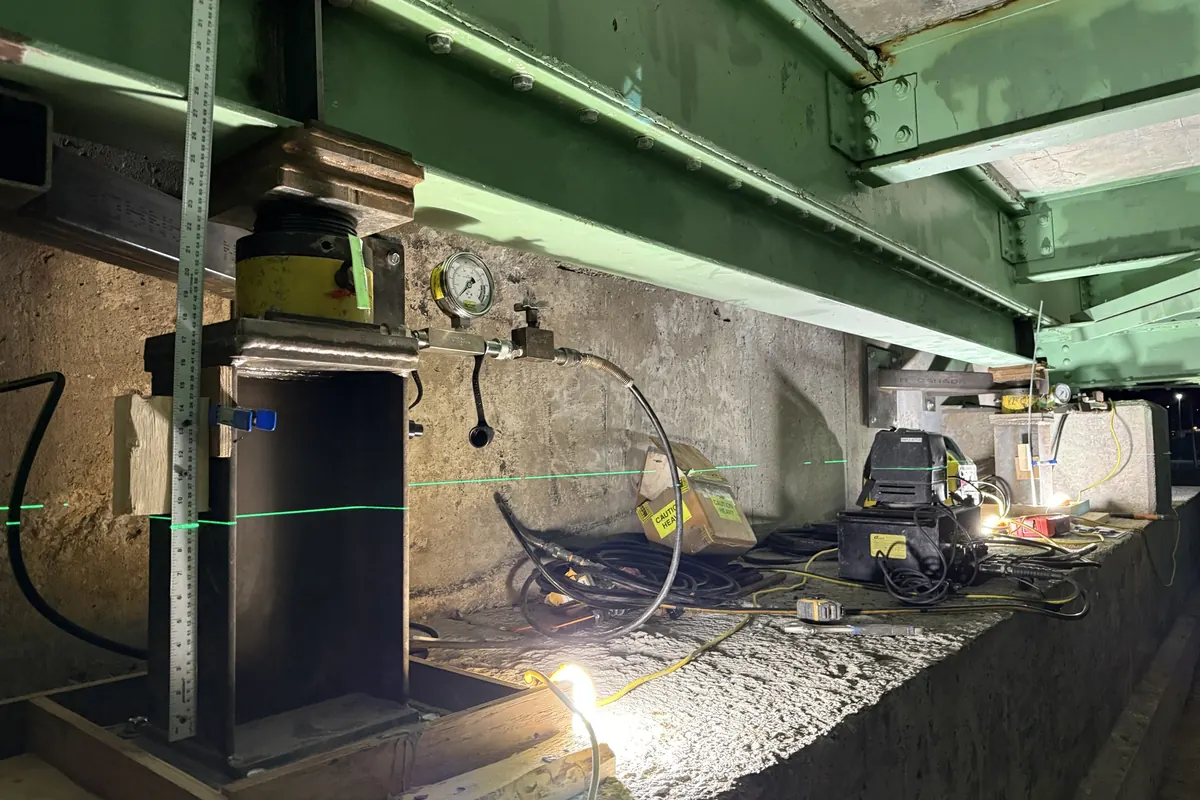
Replacing the bearings required lifting the deck by a few millimetres, then holding it on a temporary structure during the work, without closing the road link.
The main challenge lay in the amplitude: lift enough to free the bearings, little enough to constrain nothing. Twelve millimetres at the jack, a millimetre and a half of permitted offset between two girders, progression in three-millimetre increments. Lifting also rotates the bridge’s articulated joints, whose condition governed the operation.
Main services provided
Temporary deck support — Design of the steel structure taking the deck at each bearing, sized for traffic loads rather than self-weight alone: the road link stays open for the full duration of the support.
Lifting and lowering procedure — Pressure stages defined jack by jack, lifting in three-millimetre increments with the mechanical lock reset at each stage, jacks on the same axis fed by a single pump for uniform lift.
Verification of conditions before lifting — Inspection of seatings and clearances to confirm the deck is free to rise, and separation of the deck from the abutment before loading.
Lateral restraint and thermal movement — Devices taking horizontal forces during bearing removal, and allowance for thermal movement of the deck throughout the supported period.
Equivalence of the lifting system — Proposal and justification of a system equivalent to the one specified in the contract documents, submitted for approval by the resident engineer and the owner.
Monitoring and certification — Settlement measurement after loading, movement monitoring, certificate of conformity before each lift, and site visits.
Why we are proud of it
A federal bridge on the border between two provinces sets its own rules: a federal owner and resident engineer, and a New Brunswick seal to obtain before sealing the drawings. NadeauSDM also holds the right to practise in Ontario and has worked in Nunavut: the group follows its clients to wherever their sites are.
The solution therefore had to be sound, but also approvable by every party involved. Twelve millimetres of lift, a millimetre and a half of tolerance between two girders, and a road link that stays open: this is the kind of mandate where the margin is counted in millimetres.
Thanks to Bema Construction and the teams involved.